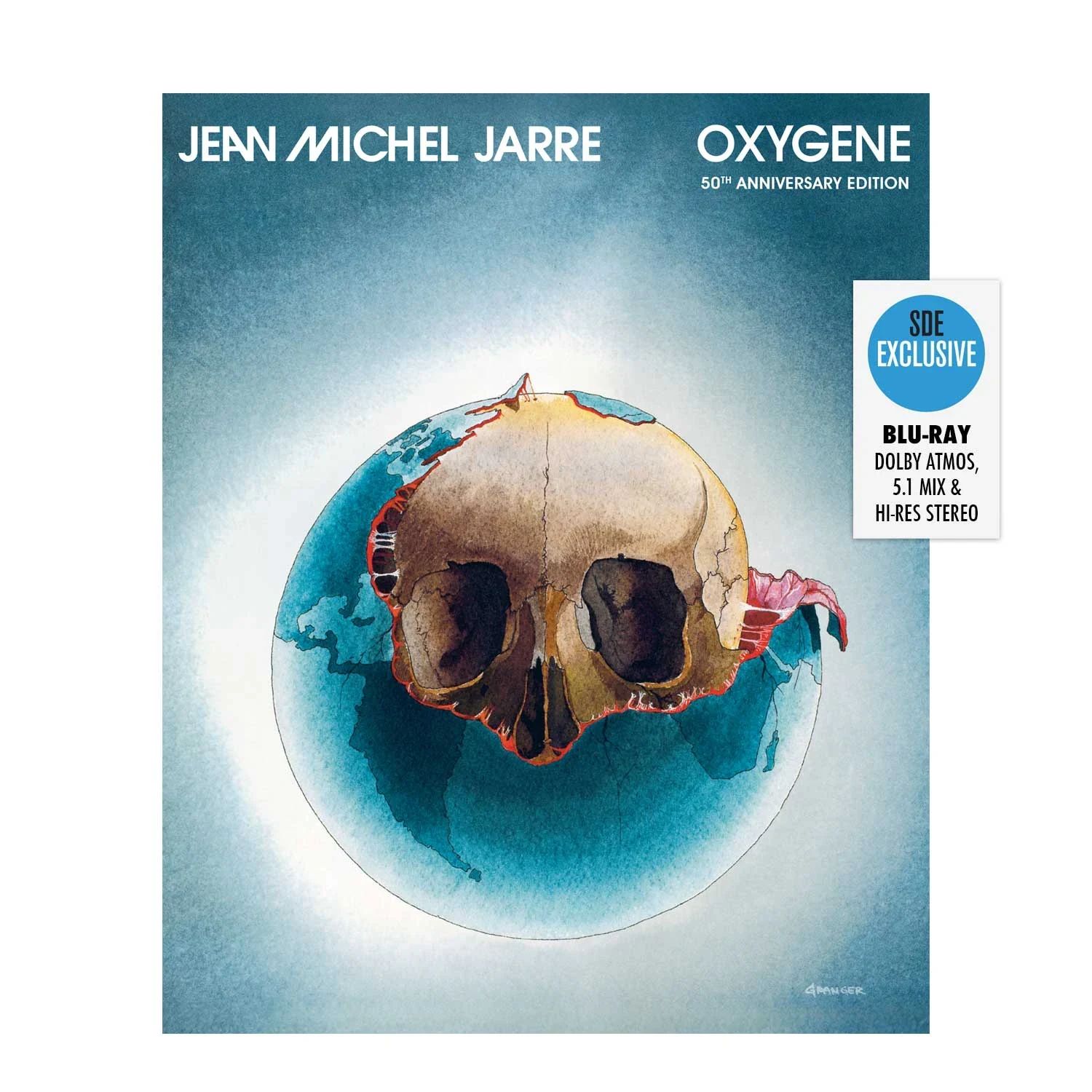
Choose the anniversary Oxygène by deciding whether you want the 1976 stereo mix or a new way of presenting the album. The announced CD and LP editions serve listeners who want the original mix in its 2026 remastered form. The SDE-exclusive Blu-ray adds new Dolby Atmos and 5.1 mixes, a headphone-focused binaural presentation, and video extras—while also including the remastered 1976 stereo mix. A separate artist-store seven-inch is different again: it contains single edits of Parts 4 and 6, not the complete album.
The distinction matters more than the format names. A new transfer of an existing stereo mix does not rearrange the music across additional speakers; a new mix from the multitracks can. If you already own Oxygène, ask which of those changes you actually want before choosing another copy.
What Each Edition Contains
The full album has six parts. The Blu-ray lists Oxygène (Part I) through Oxygène (Part VI) across each of its four audio presentations. The 180g LP divides those same six parts between side A, Parts 1–3, and side B, Parts 4–6. The single instead selects edited versions of two parts.
| Edition or presentation | Album coverage | Main reason to choose it |
|---|---|---|
| Anniversary CD | Announced as the album’s CD reissue | A physical CD route to the anniversary stereo remaster; check the particular listing before ordering. |
| Oxygene (50th Anniversary Remastered Edition) 180G Heavyweight Vinyl | Six parts, split 1–3 / 4–6 | The original stereo mix on a one-disc LP. |
| Jean-Michel Jarre / Oxygène SDE exclusive blu-ray | Six parts in four audio presentations | Compare the original stereo mix with Atmos, 5.1 and binaural; also get the video extras and booklet. |
| Oxygene 7 Inch Vinyl | Parts 4 and 6, both single edits | The 1977 single pairing recreated with 2026 stereo remasters—not an album substitute. |
The CD and LP were announced for 20 November 2026; the Blu-ray is listed for 4 December 2026. The artist-store seven-inch also lists 20 November. These are release dates, not a reason to assume every edition can currently be ordered.
Original Stereo Remaster or a New Mix?
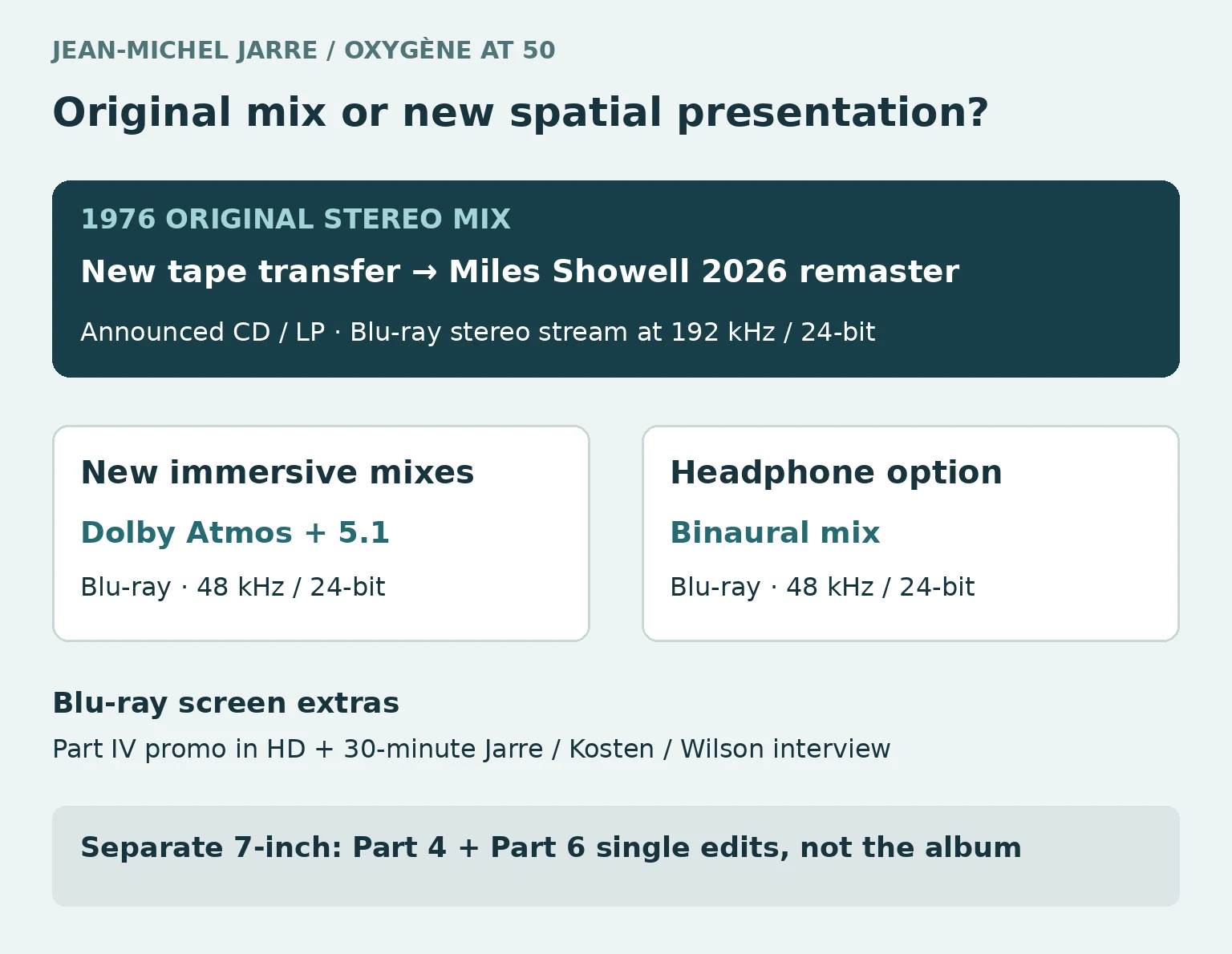
Miles Showell’s 2026 remaster starts with a new transfer of the original analogue stereo tapes. The important word here is stereo: this is the 1976 mix newly transferred and remastered, rather than an attempt to recreate it from the multitracks. The artist-store LP description identifies that transfer as the basis of the anniversary stereo release; the Blu-ray specifically labels its version “1976 Stereo Mix – Unlimited Miles Showell 2026 Remaster.” “Unlimited” is the disc’s stated mastering designation, not a promise that one format will sound better than another in your system.
David Kosten’s booklet notes help explain why keeping that mix available matters. He describes the original production’s striking left/right relationship: a dry sound on one side and its repeating tape echo on the other. Those placements are part of how the familiar stereo album was assembled. If that fixed relationship is what you mean by “the original Oxygène,” the stereo remaster is your starting point, whether you choose an announced CD or LP, or the stereo stream on the Blu-ray.
The 2026 Dolby Atmos and 5.1 mixes, credited to Kosten, Steven Wilson and Jean-Michel Jarre, instead work from the original multitracks. They contain the same six album parts but offer different spatial decisions. That makes them alternatives for hearing the album, not replacements for the historical stereo mix. Buying the Blu-ray gives you both approaches on one disc; buying the LP for the original mix does not give you the new surround mixes.
What the Four Blu-ray Audio Options Mean
The SDE Blu-ray listing specifies Dolby Atmos at 48 kHz/24-bit, 5.1 at 48 kHz/24-bit, the 1976 stereo mix remastered in 2026 at 192 kHz/24-bit, and a binaural mix for headphones at 48 kHz/24-bit. These are four presentations of the six-part album, not four albums or an expanded track list. The higher stated stereo sample rate should not be read as a verdict against the new mixes; resolution figures describe the listed streams, not what a given listener will prefer. Nor is 192 kHz/24-bit a specification for playback from the vinyl LP.
The binaural option is particularly easy to misread. It is the disc’s headphone-designated way to hear the album, not a fifth, separately announced album and not evidence that headphones reproduce the physical speaker arrangement of Atmos. A headphone listener curious about a spatial presentation can therefore find a relevant option on the Blu-ray without buying surround speakers. A listener seeking the original mix can simply select its stereo stream instead.
Kosten’s notes give concrete examples of what the new spatial mixes set out to do. He says the trailing echoes move around the space in Part II, rather than always retaining the original fixed left/right positions. At the end of Part III, he describes sounds converging at the centre before birdsong reappears above through height speakers. His account of Part V places drums and bass moving around the listener while melodies occupy multiple positions; for Part VI, he describes the ocean moving from front to back and a seagull moving through the scene. These are the mixer’s descriptions of decisions in the new versions, not a guarantee that every playback setup will produce an identical impression.
Check the equipment before choosing the Blu-ray primarily for Atmos. The disc requires a Blu-ray player. The shop says Atmos decoding requires a certified Atmos soundbar or an Atmos-compatible receiver or amplifier with an appropriate speaker setup. It also says the Atmos mix will fold down to 5.1 on a 5.1 system without an Atmos decoder, with elements intended for height speakers played through other channels. The disc is listed as region-free, but region-free does not remove the need for the right player and audio equipment.
Are the Video Extras Worth Choosing the Blu-ray for?
The screen content is focused, not a concert film or a visual accompaniment to all six parts. The Blu-ray includes the original “Oxygène (Part IV)” music video upgraded to HD, plus an exclusive 30-minute video interview with Jarre, Kosten and Wilson, conducted at Abbey Road Studios during the remastering sessions. If you want to see the original Part IV promo or hear the participants discuss the release, these are reasons to choose the disc even if you intend to play its stereo audio rather than Atmos. They are not included by buying the separate seven-inch of the Part 4 single edit.
The physical presentation adds another distinction. The SDE edition is listed in hardcover media-book packaging with a 48-page booklet. It includes essays by Alexis Petridis and Alma Rota and Kosten’s Atmos-mixing notes, with those texts in French and English, alongside images from Jarre’s Machines: A History of Electronic Music. For a buyer interested in why the new mixes were made as they were, that material complements the interview; it does not change the album coverage.
Which Should You Choose—and What Can You Order?
If you own an earlier stereo copy and like its mix, first decide whether a new transfer and remaster is itself the attraction. If it is, the anniversary CD or LP is the direct route; the Blu-ray’s stereo stream gives you that mix too, alongside presentations you may never use. Do not buy surround solely on the assumption that it is a more faithful version of the stereo original.
If you listen on headphones, the Blu-ray is the one listed here with a dedicated binaural option, as well as the original stereo remaster for comparison. If you have a 5.1 or Atmos setup, it is also the edition that offers the new multichannel mixes. If you collect singles, the seven-inch is complementary: its side A is “Oxygene (Part 4) [Single Edit]” and side B is “Oxygene (Part 6) [Single Edit].” Choose an album edition as well if you want the complete Parts I–VI sequence.
In the shop listings checked on 25 October 2026, the SDE Blu-ray and artist-store seven-inch are marked sold out, while the artist-store 180g LP shows pre-order. The CD was announced, but no current CD ordering status is established here. Check the exact edition’s listing when you are ready to buy: stock can change, while the underlying choice remains the same—original stereo album, newly mixed album, video-and-booklet package, or edited single.