Choose by which music you want, then by disc format. The familiar 1965 soundtrack album has 16 tracks; the expanded film-score programme has 46 entries, including songs, reprises, underscore and music not used in the finished film. The 4CD/Blu-ray Audio Super Deluxe Edition adds the original album programme, alternate versions, instrumentals and a Blu-ray with two distinct audio programmes. The deluxe 2CD and 3LP carry the same 46-entry score, but not those Super Deluxe additions. Most importantly for Atmos buyers, the Blu-ray’s Dolby Atmos mix covers the 16-track original album, not the entire 46-entry score.
These are recordings associated with Robert Wise’s 1965 film starring Julie Andrews, rather than a cast album of the 1959 stage production. Titles such as My Favorite Things and Edelweiss appear in more than one programme, but the programmes do different jobs. An album track, a film-version cue, an alternate and an instrumental should not be counted as four new songs—or assumed to be interchangeable just because they share a title.
First Decide Whether You Want the Album or the Film-score Journey
The original soundtrack is the concise, 16-track album programme. It opens with “Prelude and The Sound of Music” and includes the familiar album selections of “I Have Confidence,” “Do-Re-Mi,” “The Lonely Goatherd,” “Something Good” and “Edelweiss.” If what you want is that established sequence, the original album—not a set described only as the “full score”—is the target. In the Super Deluxe box, its 16 tracks occupy the beginning of CD 3 and are also offered on the Blu-ray in both 96 kHz/24-bit stereo and Dolby Atmos.
The 46-entry expanded score is for following the music through the film’s broader progression. It includes film versions of songs, shorter passages, reprises, orchestral underscore and the ending cues. Craft’s description of the expansion also encompasses material prepared for the film but not used in its completed version. “New Governess,” for example, is listed in the score programme even though Craft says it was ultimately unused. So “full film score” does not mean every entry can be heard in the final film; it identifies the expanded score collection presented by this release.
The track lists make the distinction concrete. In the score, “Overture” and “Preludium (Dixit Dominus)” are separate entries; on the original album they form one “Overture and Preludium” track. The expanded sequence also makes room for “The Little Dears,” “The Gazebo” and “The Captain Apologizes,” then later “Unthinkable,” festival reprises and “Escape.” Those entries explain why a listener interested in the film’s transitions and dramatic cues needs more than the original 16-track album. Conversely, someone who mainly wants the familiar album order need not buy 46 score entries merely to obtain its songs.
For example, if your reference point is putting on the soundtrack album and singing along from “Maria” through “Edelweiss,” prioritize the original programme. If you are looking for the music around Liesl’s gazebo scene or the cues between major songs, look at the expanded score. Both choices contain recognizable Sound of Music music, but they answer different questions about it.
The Super Deluxe CD layout helps prevent a common counting mistake. CD 1 contains the first 25 score entries. CD 2 begins with the remaining 21, ending at “End Cast.” Its last four tracks are separate spoken items: “Richard Rodgers Speaks,” a Robert Wise interview, a Richard Rodgers interview and a Charmian Carr interview. The deluxe 2CD takes the 25-plus-21 musical entries, making 46; it does not include those four spoken extras. Nor is the 46-entry score a second, longer sequencing of the 16 original-album tracks with empty space filled between them. The releases identify album versions and film versions separately.
What the Super Deluxe Box Adds Beyond the 46-entry Score
The four CDs in the Super Deluxe Edition have 100 indexed entries: 25 on CD 1, 25 on CD 2, 20 on CD 3 and 30 on CD 4. That is a count of track entries across overlapping programmes, not 100 distinct compositions. The label’s “over 40 previously unreleased tracks” describes material across the larger collection as announced for this edition; it does not mean more than 40 new songs, or more than 40 tracks exclusive to CD 4. Some of those previously unreleased entries belong to the expanded score available on the smaller deluxe editions.
After CD 3’s original-album 16 come four additional entries: “I Have Confidence (Demo Version),” “Salzburg Montage (Discrete Version),” “Sixteen Going on Seventeen (Reprise) (Film Version)” and “Edelweiss (Without Chorus).” They are additions to that disc, not part of the original 16-track album sequence. Craft identifies singer Marni Nixon with the “I Have Confidence” demo; that specific credit should not be generalized into a claim about who sings every alternate elsewhere in the box.
CD 4 is the reason to consider the box if your main interests are alternate performances or vocal-free accompaniment. Its first 11 entries are labelled alternate versions. They include the opening “Prelude and The Sound of Music,” “I Have Confidence,” “Sixteen Going on Seventeen,” “My Favorite Things,” the title-song reprise, “Edelweiss (Duet),” “The Laendler,” “Climb Ev’ry Mountain,” the “My Favorite Things” reprise, “Something Good” and the “Sixteen Going on Seventeen” reprise. These are alternatives associated with known pieces, not 11 additional compositions. Craft describes early playback recordings used for performers to match while filming and notes that recordings could subsequently change; that production background is a reason to take an interest in variants, not proof that every CD 4 alternate represents the same kind of change.
The other 19 entries on CD 4 are instrumentals, a separate group rather than 19 more alternate vocal takes. The list includes instrumental versions of “Maria,” “Do-Re-Mi,” “My Favorite Things,” “So Long, Farewell” and “Something Good,” alongside reprises. “Processional and Maria” is divided into instrumental Parts 1 and 2, and the programme includes instrumental festival reprises of “Do-Re-Mi,” “Edelweiss” and “So Long, Farewell.” It is not an instrumental duplicate of all 46 score entries, nor a simple one-for-one instrumental copy of the 16-track album.
For a home sing-along, those tracks offer recorded accompaniment without the corresponding lead-vocal presentation listed elsewhere in the set. For example, someone planning to sing “Do-Re-Mi” could choose its CD 4 instrumental rather than the vocal score entry. The package describes audio instrumentals; it does not list a video-karaoke programme or on-screen synchronized lyrics. If you chiefly want to examine recording choices, the 11 alternates are the attraction. If you chiefly want accompaniment, check the 19 instrumental titles for the particular song or reprise you intend to use.
That distinction also clarifies what the deluxe 2CD and 3LP cannot do. Both provide the 46-entry expanded score, including previously unreleased score cues, but neither supplies CD 4’s alternate-and-instrumental programme or CD 3’s separate original-album presentation. Buying a score-only edition and expecting every advertised “previously unreleased” category would therefore be a mismatch.
What Is—and Is Not—on the Blu-ray Audio Disc
The Super Deluxe box’s fifth disc is Blu-ray Audio, with two listed music programmes. One is the 46-entry full score in 96 kHz/24-bit stereo. The other is the 16-track 1965 original soundtrack programme, available in 96 kHz/24-bit stereo and a Dolby Atmos mix. The format distinction matters more than the general promise of “hi-res” or “immersive” audio: the published listing does not offer an Atmos mix of all 46 expanded-score entries. It also does not list the 100 CD entries as a Blu-ray programme.
If “I want the original soundtrack album in Atmos” is your reason for buying, the Blu-ray Audio disc directly addresses it. If your reason is “I want every piece of expanded film music in Atmos,” this edition’s track listing does not support that expectation. Likewise, the presence of a Blu-ray does not turn the set into a Blu-ray movie edition: the published programme identifies audio tracks, not a feature-film video presentation. You will need Blu-ray Audio playback for the disc and an Atmos-capable playback chain to use its Atmos option; ordinary CD playback is sufficient for the four CDs but will not provide the Blu-ray mixes.
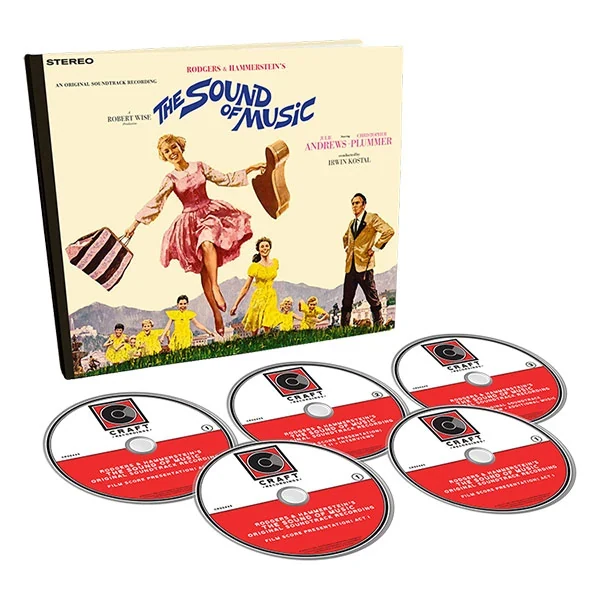
Craft credits Mike Matessino with remixing and remastering from the original multitrack tapes, and advertises his in-depth notes in the box’s 64-page hardbound-book presentation. Those credits describe the release’s preparation and contents; they are not, by themselves, a comparison of how a particular CD, vinyl setup or Atmos system will sound. Choose the Blu-ray because you want its specified programmes and formats, rather than assuming a format label guarantees a preferred listening result.
There is also a practical box-specific check. Craft’s Super Deluxe product page explicitly says “this set features corrected Disc 4 audio.” Because CD 4 holds the alternates and instrumentals, ask a seller to confirm that a particular copy includes the corrected disc if those tracks are your reason for purchasing—especially with a used or independently listed box. That note establishes what Craft says about its described offering; it does not establish the status of every copy elsewhere or a continuing replacement arrangement.
Deluxe 2CD or Black 3LP: Choose a Carrier, Not Different Music
If the 46-entry score is enough, the two smaller physical editions are alternatives, not complementary purchases needed to assemble the programme. Both follow the same score sequence from “Prelude and The Sound of Music (Film Version)” through “End Cast.” Neither adds the box’s four spoken CD 2 extras, original-album CD 3 programme, CD 4 alternates and instrumentals, or Blu-ray Atmos mix. Decide between them by the physical format you will actually play and keep.
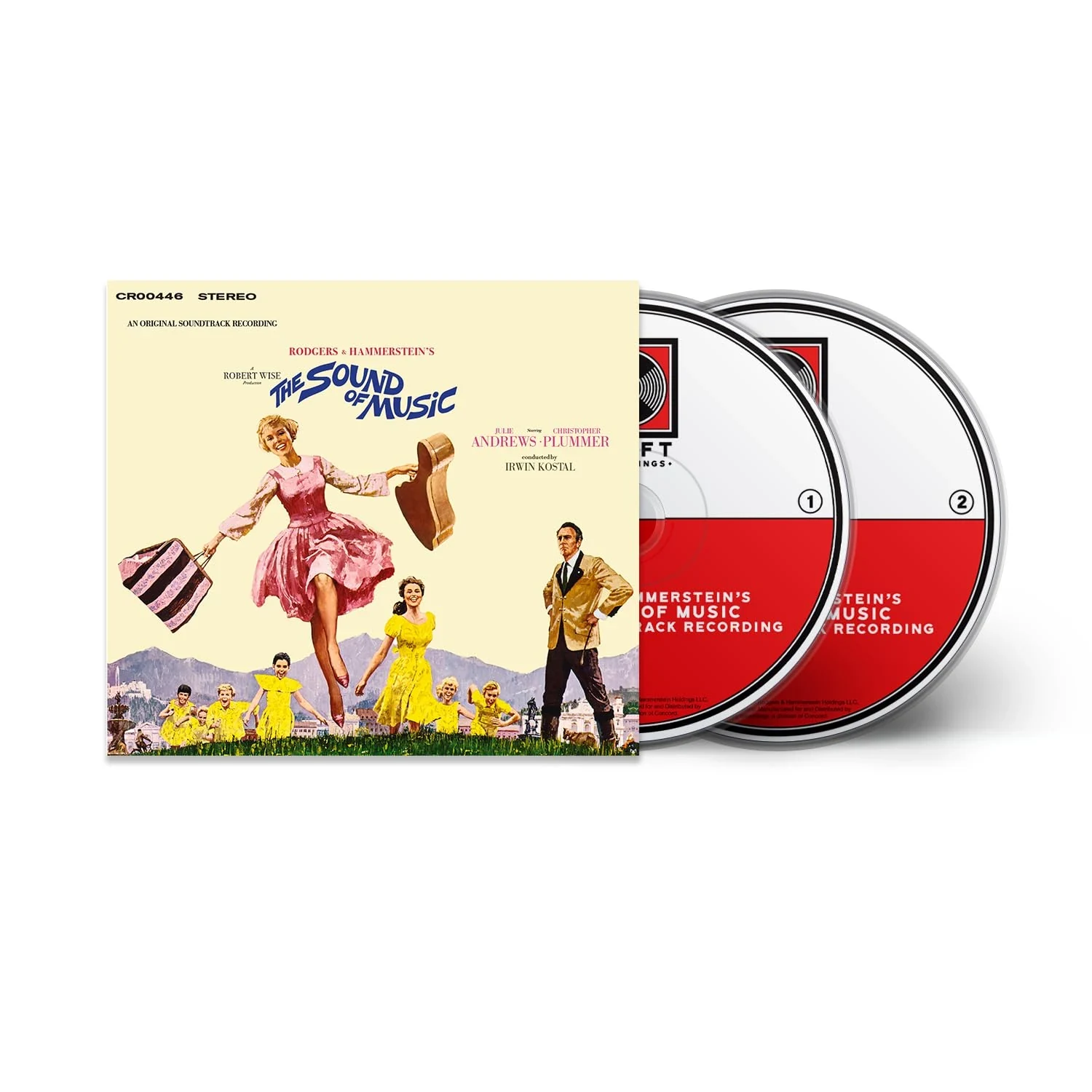
For CD: The Sound of Music — 2023 deluxe 2CD full-score edition, ASIN B0CK1GF67P, carries 25 score entries on its first disc and 21 on its second. The selected listing describes a six-panel Softpak, not the Super Deluxe hardbound book. Its product display shows the cream-coloured soundtrack front with two labelled optical discs; it should not be mistaken for a five-disc box merely because both editions use soundtrack artwork. This is the straightforward physical choice when you want the expanded score on CDs without buying the other programmes.
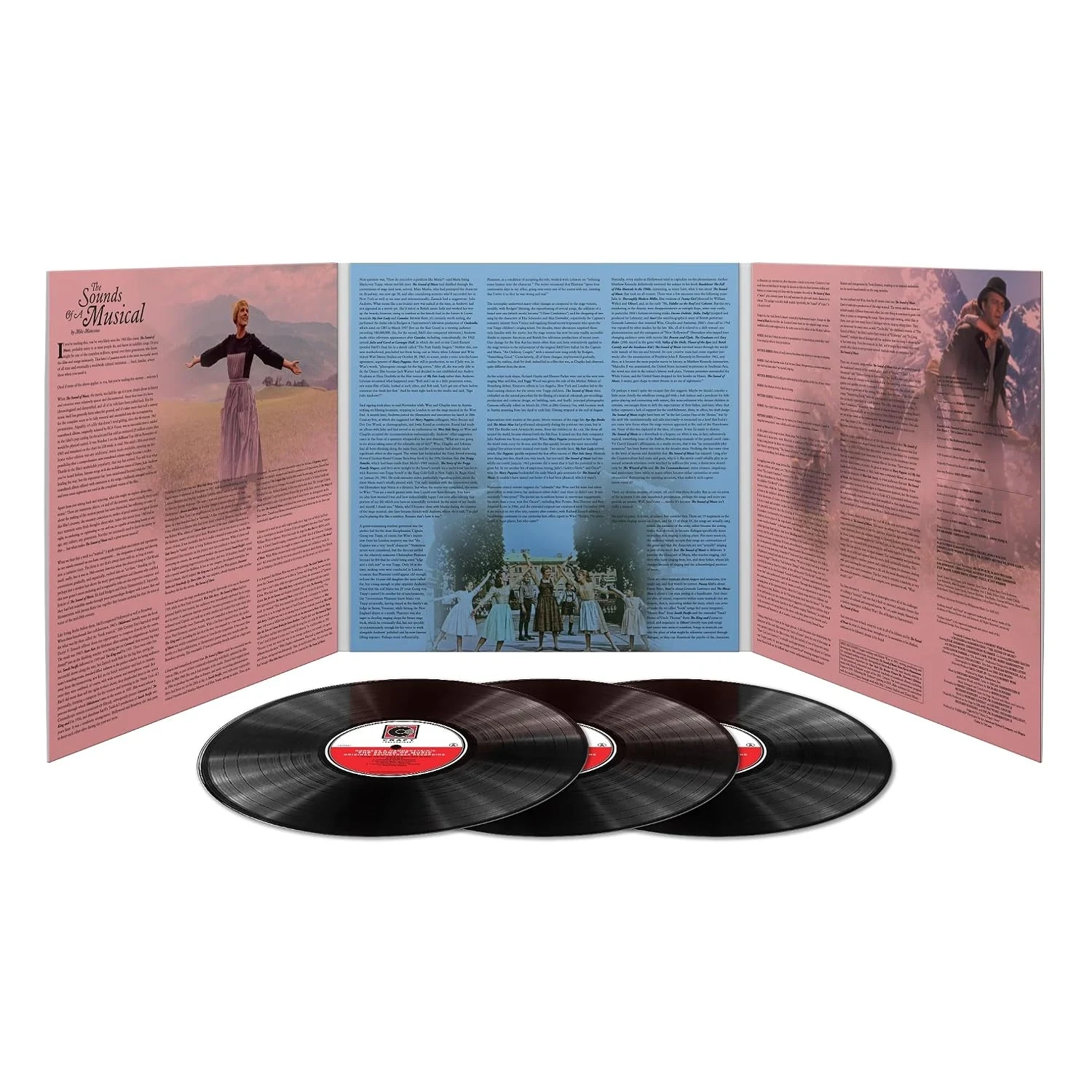
For vinyl: the 2023 deluxe black 3LP full-score edition presents those same 46 entries on three 180-gram black records in a triple gatefold. The selected product image shows the opened three-panel package, film-still and note presentation, and three black LPs. Its six sides divide the programme into 7, 6, 8, 9, 5 and 11 entries. A retailer’s online track listing may group the titles under five numbered “Disc” headings, but the release programme and product details identify three LPs, not five records.
Check the individual vinyl offer, not just the shared listing title or format selector. The saved page for ASIN B0CBNPV452 included a used-seller description explicitly warning that its offered copy was an older original release rather than the newer multidisc reissue. The selected deluxe black 3LP is also not Craft’s separately described “Picnic Meadow Green” pressing. Before ordering, confirm that the actual seller’s item is the 2023 three-record deluxe set; product code 0888072245150 is another useful identifier from the selected listing.
Vinyl’s side breaks make this a different way to handle the programme, not a source of additional cues. For example, someone who wants to follow the score continuously at a CD player might favor the 2CD; someone who wants the three-record gatefold presentation and is comfortable turning six sides might favor the 3LP. Neither choice requires buying the other to hear an exclusive score entry, and neither is a substitute for the Super Deluxe box if the desired item is an alternate performance or an instrumental sing-along track.
The Shortest Reliable Buying Decision
Start with the missing music in your own collection. For the 1965 album sequence, seek an edition that explicitly lists its 16 original-soundtrack tracks; choose the Super Deluxe Blu-ray specifically if you also want that sequence in Atmos. For the expanded film-score programme, either the deluxe 2CD or black 3LP supplies the same 46 entries, while the Super Deluxe CDs and Blu-ray also include it. For alternate versions or instrumental accompaniment, choose the Super Deluxe CD 4 programme and confirm the corrected-disc status of the copy offered.
A final track-list check is more dependable than the words “original,” “complete” or “deluxe” on their own. Look for 16 album tracks if you want the familiar soundtrack; 46 score entries if you want the expanded musical journey; and the CD 4 list of 11 alternates followed by 19 instrumentals if you want to explore variants or sing over recorded accompaniment. That separates three kinds of musical content—and keeps the Blu-ray’s 16-track Atmos album from being confused with its 46-entry stereo score.