1985 is a guide to how The Waterboys’ This Is the Sea took shape, not simply an expanded copy of the album. Mike Scott’s six-CD set places five discs of working recordings—demos, prototypes, sessions, live performances, alternate versions and mixes—before a remastered CD of the nine-track album. Both physical packages contain the same 95 audio tracks. Choose between them for the book and the way the discs are housed, not for different music.
The distinction matters if you already own This Is the Sea. Disc six supplies the familiar album sequence; the other 86 tracks are the reason to consider 1985. The release describes 64 recordings as previously unreleased at the time of its 2024 issue. That does not mean 64 newly written songs, or that every item on the first five discs was previously unavailable. The most rewarding way to navigate the set is to use its disc titles as chapters, then follow particular songs across chapters to the finished album.
What the Six-disc Sequence Actually Contains
Scott presents 1985 as a journey through the making of the album and “The Whole of the Moon.” Its five working-recordings discs are Towers Open Fire (20 tracks), The Black Book (20), A Sky Full of Crows (15), The Ladder (15) and Mountaintop (16). The sixth disc is This Is the Sea itself (nine). Those separate track positions add up to 95. Some abbreviated track lists run adjacent titles together with a slash, but “Custer’s Blues” and “The Woman in Me,” for example, occupy separate positions on disc two.
“Chronological” is a useful description of the set’s overall storytelling, not a promise that every recording dates from 1985 or that consecutive tracks document an uninterrupted session. Disc five ends with an explicitly titled “Beverly Penn 2023.” Equally, “Session” and “Live” in the listings identify kinds of recordings; they do not turn these CDs into complete broadcasts or concerts. These limits make the set easier to understand: it is a curated recording history with a deliberate ending, rather than a session-by-session tape inventory.
Disc One: Towers Open Fire Starts with Possibilities, Not a Finished Album
The first disc immediately mixes kinds of evidence. It opens with “Trumpets (Session),” follows with “Be My Enemy (Prototype 3),” and includes “The Ways of Men (Session)” and “Old England (Demo)” among its first five tracks. “Prototype 3” is a particularly useful label: it tells you where to look for an identified preliminary “Be My Enemy,” without implying that the box contains prototypes one and two. Compare it eventually with the rough mix on disc four and the album recording on disc six.
Later, tracks eight through twelve include live “Ribbon of Steel,” “Bury My Heart,” “The Three Day Man” and “This Is the Sea,” with “Medicine Bow (Session)” between the last two live titles. That stretch broadens the picture beyond private songwriting sketches. A live version of the title song gives you a different listed recording context to put beside the later studio-related versions; the track title alone does not establish precisely which arrangement decisions carried from one performance to another.
The back half returns to more provisional labels: “A Door for My Soul Home (Demo),” “The Pan Within (Inst Demo)” and “Fuzz Guitar Vamp” sit alongside titles such as “Son of Rags” and “In My Bed.” Start here if you want to see the range of material Scott has selected before the album takes over the story. Do not approach all 20 tracks as interchangeable home demos: the disc’s own listing distinguishes a prototype, sessions, live recordings, a demo and an instrumental demo.
Disc Two: The Black Book Puts the Piano and the Writing Process in View
For a listener interested in song construction, disc two offers the clearest cluster of explicitly labelled piano demos. It starts with “Beverly Penn,” “Don’t Bang the Drum” and “Be My Enemy” in that form; “Spirit” appears as a piano demo at track eight, and “The Pan Within” at track sixteen. Those labels make this a sensible chapter to consult before returning to the album versions. They identify a piano-led stage of presentation without requiring a claim that these are the first-ever attempts at each song.
“The Whole of the Moon” supplies this disc’s most direct two-stop comparison. Track fifteen is “The Whole of the Moon (Writing of),” while track twenty is “The Whole of the Moon (Piano Demo).” The titles distinguish a writing-related item from a piano demo; they do not specify, on their own, exactly what was composed between them. If your interest is one song rather than the whole archive, note both positions before going to the Livingston mix and “Video Version” on disc five, then the album track on disc six.
The titles between those landmarks also show why 1985 is wider than an album-demos collection: “The Day I Ran Out of People,” “Winter Blows,” “The Mercenary and the Samaritan,” “Paris in the Rain” and “We Belong to the World” are part of this chapter’s running order. And when checking a seller’s list, count “Custer’s Blues (Piano Demo)” at track ten and “The Woman in Me” at eleven as two entries—not one slash-titled performance. That small detail helps reconcile the disc’s 20-track count with shorter-looking transcriptions elsewhere.
Disc Three: A Sky Full of Crows Widens the Set’s Working Vocabulary
Disc three moves beyond disc two’s piano demos: “The Pan Within (Inst)” is track four, “Old England (Early Take)” six, “Spirit (Full Length)” ten and “Trumpets (Instr #1)” twelve. Use these stops to explore its instrumental, early-take and full-length entries before moving to disc four.
The closing “This Is the Sea (Drumatix Version)” at track fifteen adds another named form of the title song. It belongs on a comparison route with disc one’s live recording, disc four’s two fast lead-guitar versions, disc five’s Livingston mix and disc six’s album closer. Avoid treating “Drumatix” as a complete technical explanation of the recording: here it is the version’s published title.
There is also material that does not need to be forced into an album-song lineage. “Medicine Jack” and “Medicine Jack Boogie-Woogie” open the disc; “It Should Have Been You, Guitar Play,” “Then You Hold Me” and “Son of Dirt” appear elsewhere. “Old Macmichael Had A Band” at track seven and “Sweet Thing” at eight are separate tracks despite appearing combined in some compressed listings. For a buyer weighing how much archive is here, those individual entries matter just as much as the better-known song titles.
Disc Four: The Ladder Offers Rough Mixes and Two Named Lead-guitar Versions
Disc four opens with “Medicine Bow (Elemental Rough Mix),” puts “Be My Enemy (Rough Mix)” at track three and “Don’t Bang the Drum (Livingston Mix)” at thirteen. Pair each with its corresponding album track on disc six to compare the named alternatives.
For “This Is the Sea,” tracks six and nine are the key pair: “Fast with Mike Lead Guitar Demo” and “Fast with Tom Verlaine Lead Guitar Version.” The distinction in the published programme is between a Mike lead-guitar demo and a Tom Verlaine lead-guitar version, both identified as fast. It would be a leap to infer from those names alone that one guitarist replaced the other throughout an otherwise identical full-band recording. They are, nevertheless, the set’s most straightforward invitation to compare two specifically credited guitar-led approaches to the same song.
“Beverly Penn (Synth Version)” at track eight and “Beverly Penn” at twelve give that non-album title another route beyond its piano demo on disc two. “Trumpets (Inst #2)” follows the first numbered instrumental version on disc three, while “The Ladder (Demo)” and “Ribbon of Steel Slide Guitar” show that this disc is not exclusively about mixes of eventual album songs. Use The Ladder when you want named alternatives and rough-stage recordings in one sitting, rather than assuming it is a second presentation of the completed LP.
Disc Five: Mountaintop Approaches the Album, Then Looks Beyond It
Mountaintop opens with “The Whole of the Moon (Livingston Mix)” and has “This Is the Sea (Livingston Mix)” at track three. Together with “Don’t Bang the Drum (Livingston Mix)” on disc four, they give you three album songs to follow through versions bearing the same Livingston label, then compare with disc six.
This chapter has other well-defined stops. Track four is “Medicine Bow (Full Length),” and track five is “The Pan Within (Wickham’s First Play).” “Miracle” and “World Party (Demo)” occupy tracks six and seven separately. Later come “Born to Be Together (Session),” “Higher in Time (Session),” “Don’t Bang the Drum (Session)” and “Medicine Bow (Session).” If you want versions identified as sessions, those titles point you to them; the basic artist listing does not require you to assign each one a particular broadcaster or date.
At track eleven, “The Whole of the Moon (Video Version)” is an audio track on a CD, not a promised video disc or film. The disc ends with “Behold The Sea” and then “Beverly Penn 2023.” That final title is the clearest reason not to read the set’s name as a claim that every included recording was made in 1985. Mountaintop works both as a last collection of album-adjacent alternatives and as Scott’s chosen coda before the original album sequence begins.
Disc Six: the Nine-track Destination
The last disc presents the remastered This Is the Sea album in its nine-song order: “Don’t Bang the Drum,” “The Whole of the Moon,” “Spirit,” “The Pan Within,” “Medicine Bow,” “Old England,” “Be My Enemy,” “Trumpets” and “This Is the Sea.” This is the fixed reference for the preceding five discs. Someone buying only to acquire these nine songs does not need to mistake the other 86 track positions for 86 additional finished album songs.
A practical first play is to hear disc six, then follow one familiar title backward through the archive. Alternatively, if the making-of story is the attraction, play discs one through five in Scott’s supplied order and let the album close it. Neither route requires committing to every outtake at once. The set supports focused comparisons as well as a full six-disc journey.
Two Short Routes Through the Archive
For “The Whole of the Moon,” play disc two, tracks fifteen and twenty (“Writing of” and “Piano Demo”); disc five, tracks one and eleven (“Livingston Mix” and “Video Version”); then disc six, track two. These five labelled entries make a compact comparison route without implying that they are successive takes of one recording.
For “This Is the Sea,” begin at disc one, track twelve (live), then disc three, track fifteen (Drumatix). On disc four, play tracks six and nine for the fast Mike lead-guitar demo and Tom Verlaine lead-guitar version. Disc five, track three supplies the Livingston mix; disc six, track nine supplies the album closer. These six positions show why “five discs of working recordings” is a more useful description of the purchase than “the album plus bonus tracks”: the title song alone has several specifically named contexts to investigate.
You can make a smaller route for “Be My Enemy,” too: prototype on disc one, piano demo on disc two, rough mix on disc four, album track on disc six. These routes are listening plans based on the track identities, not claims about which recording is definitive.
Which Physical Package Should You Buy?
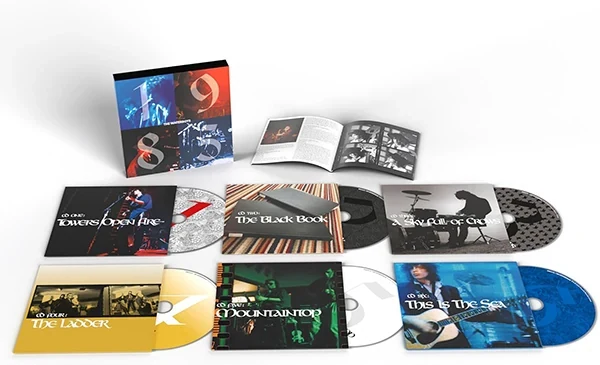
Once the music is settled, the choice is straightforward. The Waterboys — 1985 (6CD clamshell edition with card wallets), ASIN B0CVLGRX8C, puts the six CDs in individual card wallets inside a compact clamshell box, with a bound booklet. Its identifier is 0810098504645. In the published package spread, the six separately labelled wallets sit alongside the small box and booklet: it is the space-conscious way to keep this entire audio programme.
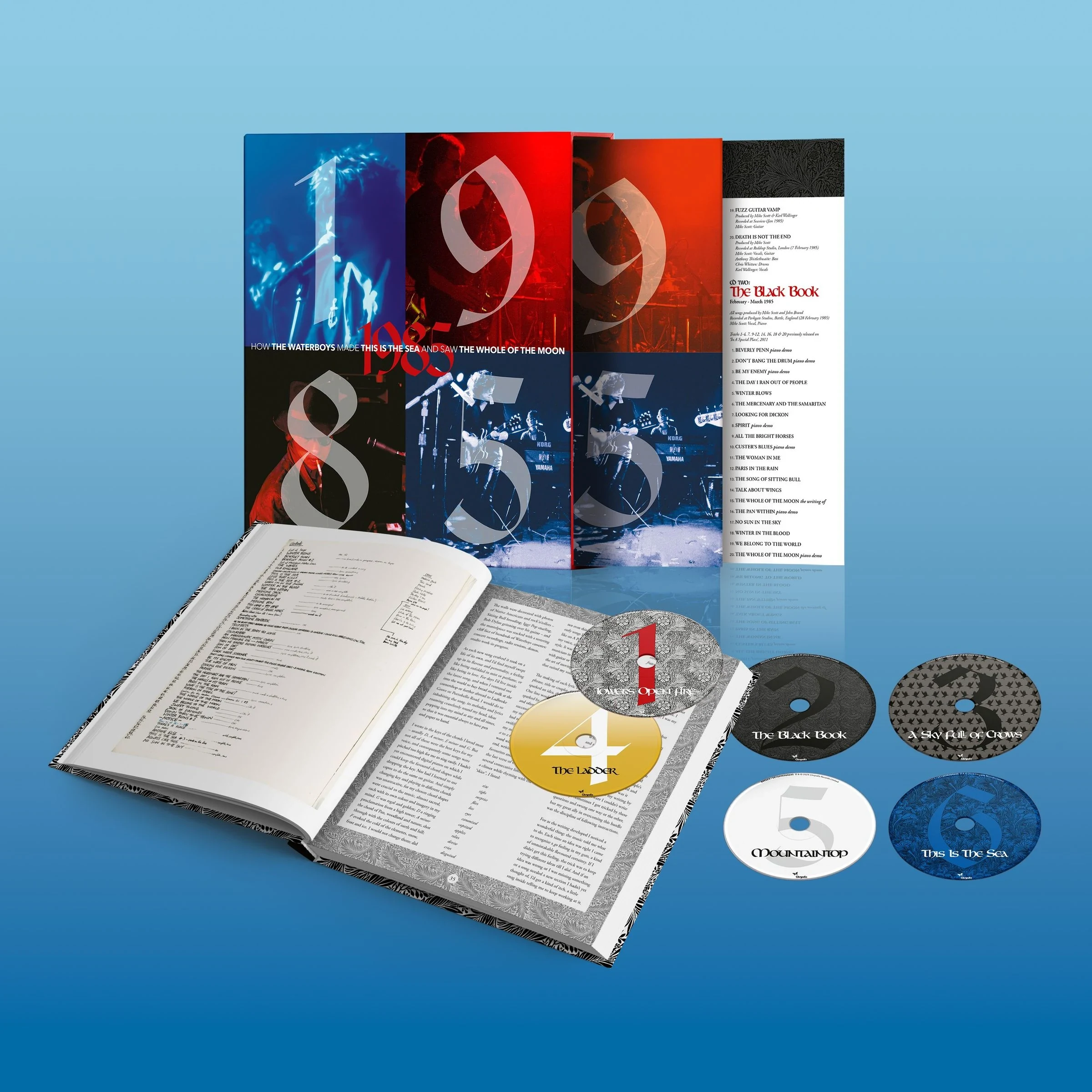
The Waterboys — 1985 (deluxe 6CD edition with 220-page hardcover book), ASIN B0CR9ZCXZ9, is the larger book-and-disc object in a rigid slipcase; its identifier is 0810098504638. The published description credits Mike Scott with the main text and Anthony Thistlethwaite and Max Edie with additional sections. It describes recording details, photographs, songwriting pages, lyrics and other writing. The promotional spread shows the substantial book open with text and disc-holding pages. Choose it if that physical account of the album’s creation is part of what you want to own and consult.
The smaller booklet is advertised as containing Scott’s recording annotations and photographs, but its page count is inconsistent across listings: the artist-store description says 56 pages in one place and 52 in its format line; another retailer says 55. Ask the seller to confirm the particular copy if an exact booklet count matters to you. The hardcover book’s stated 220 pages are a meaningful format difference; the varying compact-booklet figures are not evidence of different CD programmes.
The hardcover was described as a limited edition of 3,000, and the two formats appeared on different 2024 release schedules. Neither historical detail establishes today’s price, condition or availability. Before ordering, check the listing’s six-CD format and identifier, then check the seller’s current terms—especially for a used book edition. There is no musical-content reason to buy both: the two packages lead through the same 95 recorded tracks, from Towers Open Fire to the album itself.